Wednesday, July 5, 2017

Lina Medina - The Youngest Recorded Mother


The disturbing story of Lina Medina is the case of the youngest confirmed mother in medical history. Lina Marcela Medina de Jurado was born September 23rd, 1933 in Ticrapo, Peru. In 1939 Lina's parents took her took the doctor, concerned about an apparent tumor growing in her stomach. Both her parents and doctor were shocked to discover that 5-year-old Lina was in fact 7 months pregnant. Lina was then taken to a hospital for medical examination. There it was discovered that Lina suffered from precocious puberty, a medical condition in which a child begins puberty before their early teens. Questioning of Lima's parents revealed that she had started having periods around the age of 3. However, sufferers of precocious puberty are usually between 8-10, with Lina's extreme case being the only known case in medical history.

Lina gave birth to her son Gerardo by way of a cesarean section in September 1939. Almost immediately after her pregnancy was discovered, police began to investigate the identity of her abuser. Her father, Tiburelo Medina, was the primary suspect but he was later released due to lack of evidence, and the biological father was never identified. Lina herself was unable to identify her attacker or the circumstances of her impregnation, and it is possible that she was too young to fully comprehend what happened to her. Lina's son was raised by his grandparents and believed they were his biological parents, not discovering the truth until he was older. Gerardo died in 1979 at the age of 40. Lina Medina is still alive at age 83 and lives in Lima, Peru.

Tuesday, July 4, 2017

Canadian Annexation Bill of 1866


Although the United States made several overtures of annexing Canada in the 19th Century, the last significant effort was the failed Annexation Bill of 1866. The Annexation Bill of 1866 was a bill introduced on July 2, 1866, but never passed in the United States House of Representatives. It called for the annexation of British North America and the admission of its provinces as states and territories in the Union. The bill was sent to committee but never came back, was never voted upon, and did not become law and came to the United States Senate.

The bill authorized the President of the United States to, subject to the agreement of the governments of the British provinces, “publish by proclamation that, from the date thereof, the States of Nova Scotia, New Brunswick, Canada East, and Canada West, and the Territories of Selkirk, Saskatchewan, and Columbia, with limits and rights as by the act defined, are constituted and admitted as States and Territories of the United States of America.” It provided for the admission of all the colonies and the purchase of the Hudson’s Bay Company’s lands for $10,000,000. The American government would assume public lands and state-owned bonds and the right to levy taxes and, in return, would take over provincial debts to the total of $85,700,000 and give an annual subsidy of $1,646,000 to the new states. In addition, the United States would connect Canada with the Maritimes by rail and spend $50,000,000 to complete and improve the colonial canal system.

The bill was introduced by Congressman Nathaniel Prentice Banks, a representative from Massachusetts. It was intended to appeal to Irish Americans who supported the Irish Fenian Movement and were aggressively hostile to Britain. Indeed, much of American public opinion at the time was hostile because of Britain’s perceived support for the Confederacy during the American Civil War. There was no serious effort in Washington to annex Canada.

Its introduction and a similar interest in annexation by the United States possibly provided a little incentive for the organization of Canada as an entity distinct from Britain; indeed, the bill’s introduction preceded Canadian Confederation by less than a year. However, Fenian attacks had much more influence in shaping determination to hurry the Confederation process.

Monday, July 3, 2017

"Our Mother Europe" - What a Postcard Can Tell us About 1940s Europe


This 1942 Vichy French postcard reveals much about the current political state of Europe in the early years of WWII:


  • The United Kingdom is seen “falling victim” to the Americans and Jews
  • Neutral Sweden and Switzerland are supposedly looking longingly at “Our Mother Europe”
  • The chicks have the flags of the Axis powers (Romania, Italy, Nazi Germany, Franco Spain, Vichy France, Hungary, Slovakia?, and Finland)
  • The Post Stamp shows Philippe Petain, Nazi installed leader of Vichy France

Sunday, July 2, 2017

The Short Lived Flag of Wales


In 1953, Wales adopted the above flag as one of the official symbols. One of the new additions to the flag was a quote from a poem by 15th Century Welsh poet Deio ab Ieuan Du. The motto reads "Y Ddraig goch ddyry cychwyn" meaning 'The red dragon gives impetus.' Welsh scholars were quick to tell Welsh authorities that, in the context of the poem, the "red dragon" mentioned is alluding to a bull's penis. In 1959, the Welsh government adopted the modern Welsh flag


Saturday, July 1, 2017


John William Rogan (February 16, 1865 – September 12, 1905) is one of 17 known people in medical history to reach a height of 8 feet (2.44 m) or more. Born to former slaves in Tennessee, Rogan began to experience a rapid growth spurt once he reached 13. When he was measured in 1899, Rogan was found to be 8 ft. 9 in. tall. Despite being unable to do physical labor due to his size, Rogan refused to perform in traveling side shows, although he did make a living by selling pictures of himself. Rogan died on September 12, 1905 from complications due to his height. He was buried in the family yard under solid concrete to prevent anyone from exhuming and examining his body. Rogan was not only the tallest person of African descent ever recorded, but he is also the second tallest human being ever recorded period, beaten only by Robert Wadlow (8′11).

Friday, June 30, 2017

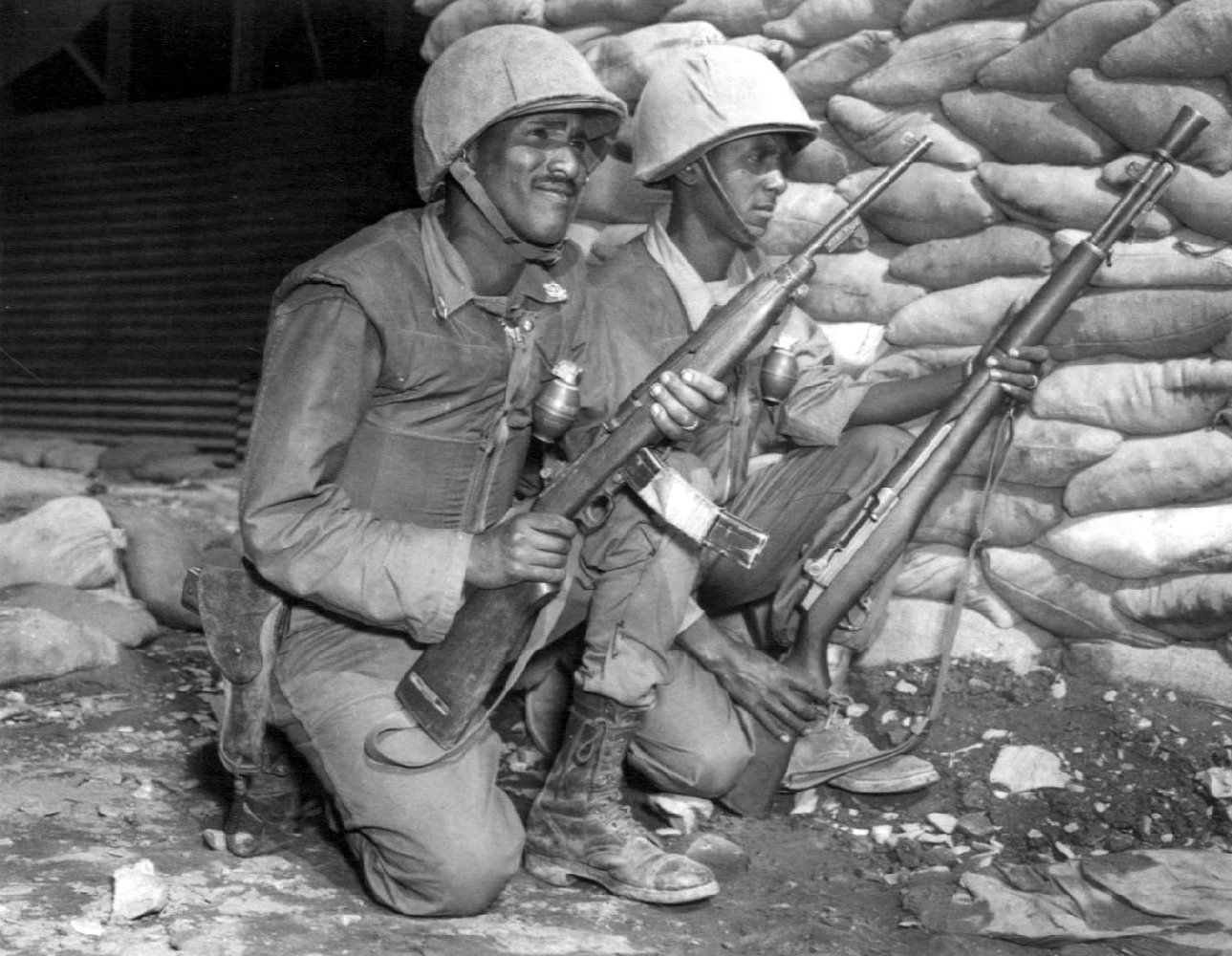
Ethiopia in the Korean War


In total, 16 nations applied troops to the United Nations forces involved in the Korean War. Ethiopia was the only African nation to do so, supplying 6,037 soldiers in total. When the Korean War began Emperor Hailie Selassie sent a battalion of troops from his own elite Imperial Guard Division known as the Kagnew Battalion, named after the warhorse of Hailie Selassie's father Makonnen Wolde Mikael. The Kagnews served with great distinction throughout war, notably being the only contingent that had no prisoners to collect from the North Koreans following the armistice, since no Kagnew soldier ever surrendered. This coupled with the fact that the battalion never left their dead behind, always retrieving the bodies of their fallen led the North Koreans, who had never seen Africans before, to believe that the Ethiopians had superhuman powers and could not be killed.

In total 121 Ethiopians were killed in the Korean War and 536 received injuries. Even after the armistice, a token Ethiopian force remained in the country until 1965. When the Communist Derg took control of Ethiopia in 1974, they did their best to erase all records of the Kagnew Battalion, but since their fall research in the battalion has grown.


Thursday, June 29, 2017

Katherine Cross - Murdered By Human Wolves


In Konawa Cemetery in Konawa, Oklahoma; a barely legible tombstone bears an unusual epitaph, "Murdered by human wolves." Little is known about the life of Katherine Cross other than what is on her tombstone. She was born March 13th, 1899 to J.T and M.K Cross, and died October 13th, 1917 at age 18. The odd cause of death on her tombstone has caused numerous local legends to arise over her death, such as she was killed by members of the KKK or by actual werewolves. In actually her real cause of death is likely something more mundane but more tragic. Examination of contemporary newspapers notes that Cross died in the care of Dr. A.H. Yates and his assistant Fredrick O'Neal, with her cause of death listed as a "criminal operation." The wording of this prognosis and her location suggests that a more likely cause of death was injuries sustained in a botched abortion. While the headstone was stolen in July 2016, the grave of Katherine Cross, murdered by human wolves, still remains in Konawa Cemetery.